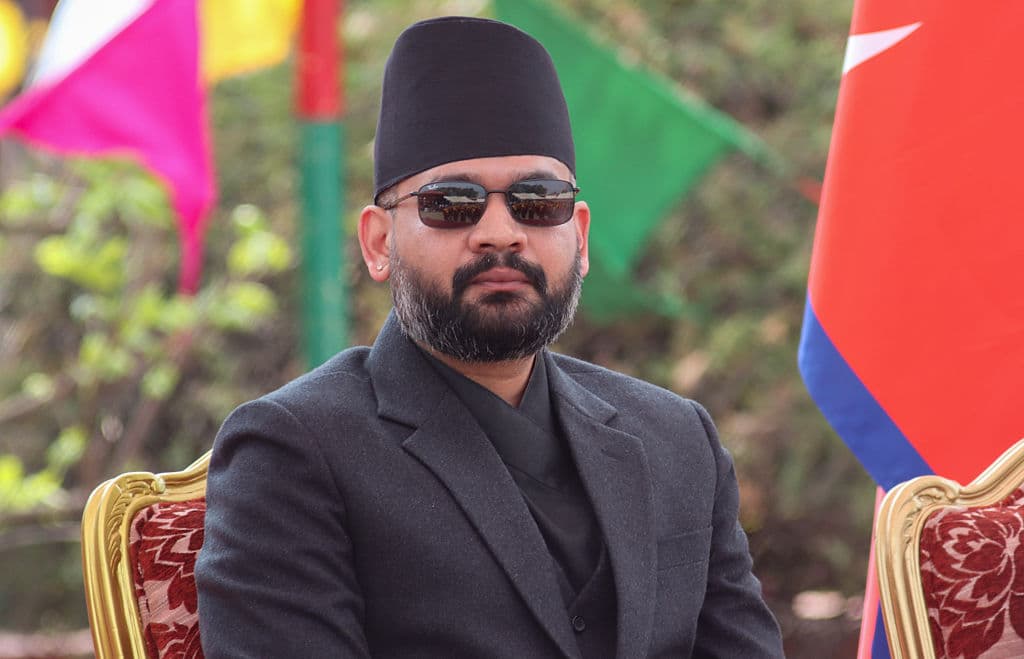
New Delhi: Nepal Prime Minister Balendra Shah arrived in New Delhi on Sunday for his first official bilateral visit to India since assuming office in March. The two-day visit, scheduled for November 22 and 23, is expected to mark an important step in strengthening ties between the two neighbouring countries.
Shah is scheduled to hold delegation-level talks with Prime Minister Narendra Modi on Monday. The visit comes amid renewed diplomatic engagement following months of uncertainty over the direction of relations between Kathmandu and New Delhi.
Shah came to power following the Gen-Z-led protests that led to the fall of the government headed by K.P. Sharma Oli. His initial diplomatic approach, including holding collective meetings with foreign ambassadors instead of individual courtesy calls, had drawn attention in diplomatic circles. Differences over certain bilateral issues also raised concerns in New Delhi.
However, diplomatic engagement continued through official visits and discussions. Nepal Foreign Minister Shisir Khanal visited India, while Indian Foreign Secretary Vikram Misri travelled to Kathmandu to prepare the ground for high-level engagement. In June, Rabi Lamichhane, chairperson of Nepal's ruling Rastriya Swatantra Party, visited New Delhi and met Prime Minister Modi.
Reconstruction and connectivity on agenda
Shah's discussions with Modi are expected to focus on three key areas: reconstruction, connectivity, and energy and trade.
The August floods in Nepal's Bhotekoshi region severely damaged roads, bridges and other infrastructure. A proposed $2 billion Indian assistance package for reconstruction and rehabilitation is expected to figure prominently in the talks.
Nepal is also seeking additional air-entry routes through Indian airspace to improve international connectivity to Bhairahawa and Pokhara airports. Limited access to air routes has affected efforts to attract major international airlines to these airports.
Energy cooperation is another major priority. Kathmandu is looking to expand electricity exports to India and Bangladesh, building on India's long-term commitment to purchase 10,000 MW of electricity from Nepal. The two sides are also expected to discuss fresh Indian investments in hydropower, trade barriers, railway and road connectivity, and border management.
Joint Vision Document to be unveiled
India and Nepal are expected to unveil a 10-point Joint Vision Document titled Samriddha Nepal, Samunnat Bharat (Prosperous Nepal, Developed India). The framework is intended to establish measurable targets for cooperation in trade, energy, education, healthcare and digital connectivity.
Several infrastructure projects are also scheduled for inauguration or the launch of construction.
These include the flagging-off of a cross-border train connecting Ayodhya in India with Janakpur in Nepal, the inauguration of the Nepal Police Academy in Panauti and the Bhairahawa Integrated Check Post.
The two countries are also expected to lay foundation stones for the Lower Arun hydropower project and a cross-border oil pipeline connecting Siliguri in India with Jhapa in Nepal.
Focus on rebuilding mutual trust
Shah's visit is being closely watched in Nepal, where opposition leaders have called for a national consensus on key bilateral issues. Former Foreign Minister and CPN-UML leader Pradeep Gyawali has stressed the need to address the trust deficit between the two countries.
For Kathmandu, the visit offers an opportunity to clarify its foreign policy priorities and strengthen its working relationship with New Delhi. For India, it provides an opening to engage directly with Nepal's new leadership and reinforce ties with an important Himalayan neighbour.