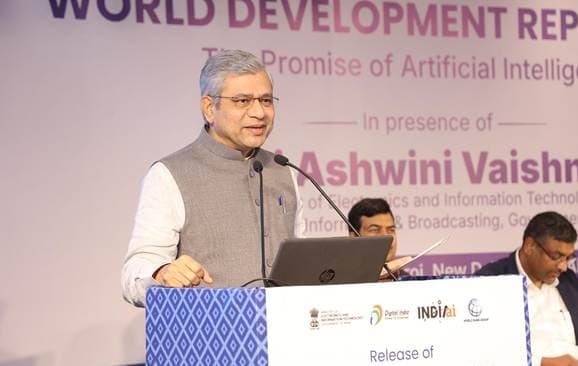
New Delhi: Artificial Intelligence is no longer limited to technology companies and research laboratories, but is increasingly being used to improve the lives of ordinary people, Union Minister for Electronics and Information Technology Ashwini Vaishnaw said on Thursday.
Speaking at the India launch of the World Bank Group’s World Development Report 2026: The Promise of Artificial Intelligence, Mr. Vaishnaw pointed to applications of AI in agriculture and healthcare as evidence of the technology’s growing impact.
He cited an initiative in Baramati where AI-supported agricultural advice helped increase sugarcane yields by 40% while reducing the use of water and fertiliser by 30%. The system allows farmers to access information through voice-based services on mobile phones, without requiring them to use computers.
In healthcare, AI-based screening has contributed to a 35% increase in TB detection, he said.
“AI is changing the lives of ordinary people,” Mr. Vaishnaw said, adding that such applications could be adapted for wider use across developing countries.
World Bank report highlights AI potential
The report examines how developing economies can use AI to improve productivity, expand access to specialised knowledge and strengthen the delivery of public services.
AI tools are already being deployed in areas such as medical screening, farming and education. However, the report stresses that technology alone cannot deliver these benefits. Reliable power and internet connectivity, computing infrastructure, quality data, skilled workers and capable institutions are essential for successful AI adoption.
The report was launched in New Delhi by the IndiaAI Mission under the Ministry of Electronics and Information Technology in partnership with the World Bank Group. Policymakers, development specialists, technology companies and practitioners participated in discussions on the opportunities and risks associated with AI.
India builds AI ecosystem
Mr. Vaishnaw said India was developing an AI ecosystem that covers healthcare, agriculture, education, governance and financial services.
The IndiaAI Mission is structured around seven areas, including computing infrastructure, development of indigenous foundation models, the AIKosh data platform, application development, future skills, startup funding and safe and trusted AI.
The government’s strategy is focused on widening access to computing resources, data and AI models while developing applications suited to India’s diverse and multilingual population.
The Safe and Trusted AI programme is supporting work on areas such as algorithmic bias, auditing, explainable AI, privacy protection and detection of deepfakes.
From experiments to solutions at scale
World Bank Group Chief Economist and Senior Vice-President Michael Kremer said India’s experience with AI could provide useful lessons for other developing economies.
He referred to AI-powered weather advisories for farmers and education technology initiatives in Andhra Pradesh as examples of technology being adapted to local requirements.
Mr. Kremer said scaling such solutions required more than software. It also involved developing the human resources, institutions and delivery systems needed to ensure that AI applications worked effectively on the ground.
He cited India’s use of AI for monsoon forecasting as another example. Multiple models were combined to generate forecasts that were subsequently made available to millions of farmers through text messages, voice services and AI-based advisories.
Report calls for practical approach
World Development Report 2026 Director Gaurav Nayyar said India was already demonstrating how AI could be adapted to local conditions, with the government playing the roles of technology enabler, user and regulator.
The report recommends that developing countries approach AI with optimism while remaining strategic and pragmatic. Instead of spending heavily on building advanced systems from scratch, countries can adopt existing technologies and tailor them to their own needs.
It also points to a preparedness gap. While developing economies could potentially gain substantially from AI, many lack the infrastructure and policy frameworks required to take advantage of the technology.
States showcase AI applications
A State AI Showcase at the event presented technology-driven initiatives from different parts of the country.
Andhra Pradesh showcased Navachetana, an AI-based early screening programme designed to identify developmental delays among children aged zero to six.
Maharashtra presented MahaVISTAAR AI, which provides farmers with personalised advisories and digital services, while Meghalaya showcased EdskGrid, a GeoAI-based platform designed to support education governance.
Another initiative, Vyuhaa-Cerviai, demonstrated the use of AI in point-of-care cervical cancer screening.
The discussions highlighted the need to move beyond individual pilot projects and build evidence-based solutions that can be expanded across regions and sectors.
Participants also stressed the importance of public trust, responsible use and strong institutional safeguards as AI becomes more deeply integrated into public services and economic activity.
The central message from the discussions was that the next phase of AI development will depend not merely on creating sophisticated technology, but on making it accessible, affordable and useful to people at scale.