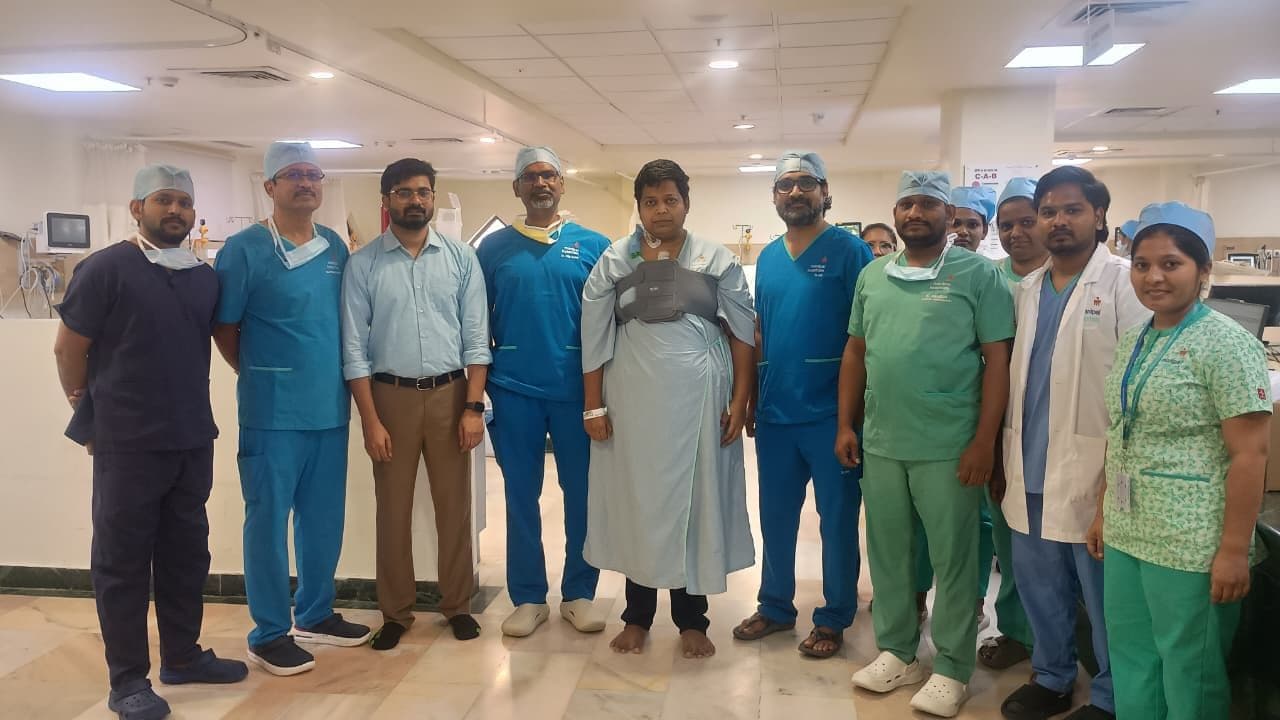
Vijayawada: At just 27, a young man was struggling to breathe, with even routine daily activities becoming increasingly difficult. Suffering from severe heart complications linked to a congenital defect diagnosed in childhood, he faced a high-risk repeat open-heart surgery. A complex cardiac procedure at Manipal Hospitals Vijayawada has now given him fresh hope for a healthier and more active life.
The patient's medical journey began with Tetralogy of Fallot (TOF) with absent pulmonary valve syndrome, a rare congenital heart condition. At the age of 10, he underwent corrective surgery during which a 17-mm mechanical pulmonary valve was implanted.
Over the years, as he grew into adulthood and his body weight reached approximately 130 kg, the existing valve became inadequate for his circulatory requirements. This resulted in severe patient–prosthesis mismatch (PPM), a condition in which an artificial heart valve is too small relative to the patient's needs. The mismatch contributed to pulmonary valve obstruction and right ventricular failure.
His condition was further complicated by significant narrowing of the right ventricular outflow tract (RVOT), massive dilatation of the branch pulmonary arteries and severe aortic regurgitation, in which blood flows backwards through the aortic valve.
With his condition reaching New York Heart Association (NYHA) Class IV, indicating severe limitations due to cardiac symptoms, the patient required comprehensive surgical intervention. His previous heart surgery, multiple structural abnormalities and obesity added to the complexity of the procedure.
Complex surgery to replace two heart valves
The cardiac surgery team at Manipal Hospitals Vijayawada undertook the challenging redo operation, addressing multiple complications affecting the patient's heart.
During the procedure, the existing 17-mm mechanical pulmonary valve was replaced with a larger 25-mm mechanical valve. The surgeons also reconstructed the right ventricular outflow tract and pulmonary artery to address the associated structural abnormalities and improve blood flow.
The aortic valve presented another major challenge. To accommodate an appropriately sized prosthetic valve and reduce the risk of another patient–prosthesis mismatch, the surgical team enlarged the aortic root before implanting a 25-mm mechanical aortic valve.
The operation required detailed preoperative planning and precise execution, as the team had to correct several structural abnormalities in a patient who had already undergone major heart surgery. The procedure also required coordinated efforts from the cardiac surgery, anaesthesia and critical care teams.
Financial assistance supports treatment
Financial difficulties had made it challenging for the patient's family to access the treatment he urgently needed. Assistance through the Chief Minister's Relief Fund helped the family proceed with the surgery.
Following the procedure, the patient made steady progress and is now reported to be stable. He has been shifted from the intensive care unit to the general ward and is expected to be discharged shortly, subject to his continued recovery and medical assessment.
Commenting on the case, Dr. Dilip Ratti, Consultant, Cardiothoracic and Vascular Surgery (CTVS), Manipal Hospitals Vijayawada, said that redo heart surgery in a young patient with multiple complications required detailed planning and a coordinated surgical approach.
The team had to address problems involving two heart valves, abnormal blood flow and narrowing within the heart while accounting for the risks associated with the patient's previous surgery and obesity, he said.
The patient's steady recovery was encouraging, and the team hoped that the treatment would help him lead a more active and healthier life, Dr. Ratti added.
Advanced cardiac care
The successful procedure highlights Manipal Hospitals Vijayawada's capabilities in managing complex cardiac conditions that require advanced surgical intervention. Such redo procedures can be particularly challenging because surgeons must address existing complications while navigating changes caused by previous operations.
For the young patient and his family, the surgery marks a significant step towards an improved quality of life after years of living with a serious heart condition. His recovery also underscores the importance of specialised cardiac care, multidisciplinary teamwork and access to financial assistance for patients requiring complex treatment.