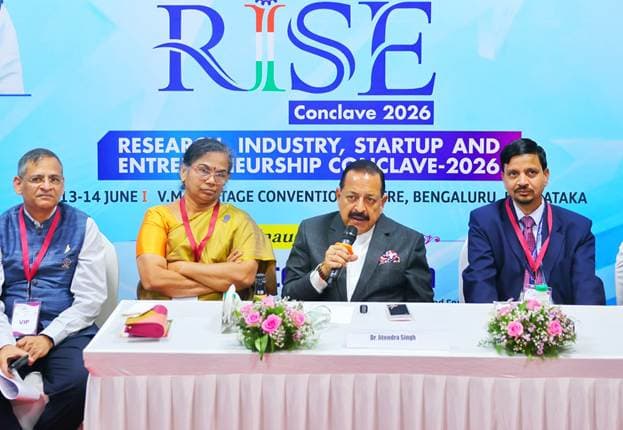
India's space economy is expected to witness exponential growth over the next decade, expanding from its current value of approximately USD 8-9 billion to nearly USD 40-45 billion, Union Minister Dr. Jitendra Singh said while addressing a press conference during the RISE Conclave 2026.
The Minister, who holds key portfolios including Science & Technology, Earth Sciences, Space, and Atomic Energy, attributed this projected growth to a combination of policy reforms, increasing private sector participation, and a rapidly evolving innovation ecosystem. He noted that India’s space sector transformation reflects a broader national shift in which science and technology have moved beyond laboratories to become integral to public consciousness and national development.
Dr. Singh emphasized that one of the most significant achievements in recent years has been the growing connection between science and society. According to him, citizens today increasingly view themselves as stakeholders in India's scientific progress, creating a stronger foundation for innovation-led development.
He credited Prime Minister Narendra Modi’s vision for bringing science and technology into mainstream national discourse through initiatives such as Swachh Bharat, Digital India, Digital Health, Deep Ocean Mission, and the Gaganyaan programme. These initiatives, he said, have helped place scientific innovation at the center of India’s development agenda.
Highlighting India's achievements in the space sector, Dr. Singh said landmark missions such as Chandrayaan-3 have elevated India's status among the world's leading space-faring nations while also generating unprecedented public interest in space science. He added that India’s upcoming Gaganyaan Programme is expected to further strengthen the country's global standing.
The Minister also pointed to the remarkable rise of India's private space ecosystem. While only a handful of space startups existed a few years ago, the country now boasts more than 400 space startups contributing to technological innovation, satellite applications, launch technologies, and space-based services.
Dr. Singh stressed that India has successfully leveraged space technology for governance and infrastructure development. Programmes such as PM Gati Shakti, urban development initiatives, and drone-enabled monitoring systems are helping improve project planning, implementation, and monitoring while enhancing transparency and efficiency.
According to the Minister, India's growing capabilities in frontier sectors such as space, atomic energy, artificial intelligence, and deep technologies are strengthening the country's global competitiveness. He noted that Indian technologies are increasingly gaining acceptance in international markets, reinforcing India's reputation as a trusted technology partner.
Addressing concerns regarding recent mission challenges, Dr. Singh said every major space programme evolves through continuous learning. He confirmed that the analysis of the recent PSLV mission anomaly has been completed, underlying causes have been identified, and corrective measures have already been initiated to strengthen future missions.
The Minister said India's scientific achievements are increasingly contributing to economic growth, technological self-reliance, and strategic capability. He emphasized that the combined efforts of startups, industry, research institutions, and policymakers are creating a robust innovation ecosystem capable of driving the vision of Viksit Bharat 2047.
The RISE Conclave 2026, themed "Innovation & Entrepreneurship Driven Growth for Viksit Bharat 2047," brought together researchers, startups, investors, industry leaders, and policymakers to foster collaboration and accelerate the transformation of scientific research into real-world economic and societal outcomes. More than 125 startups and technology innovators showcased cutting-edge solutions spanning aerospace technologies, artificial intelligence, deep-tech innovations, and agri-food technologies during the event.