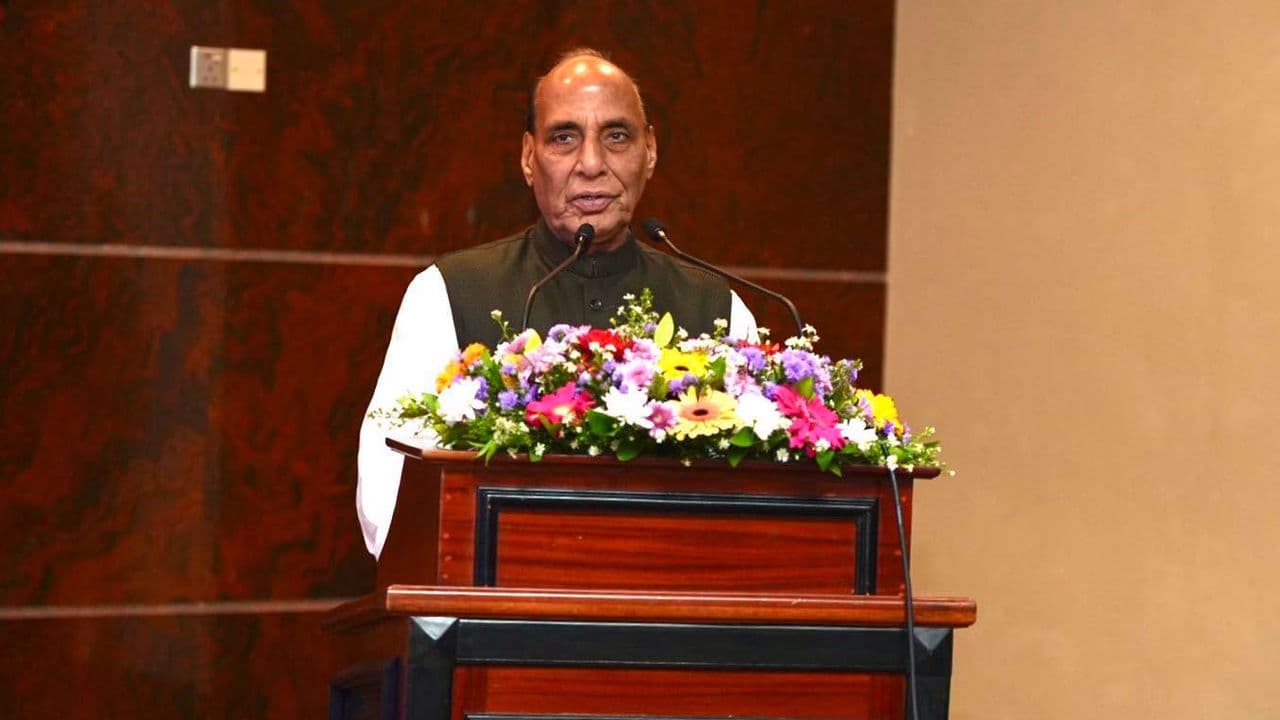
New Delhi: Defence Minister Rajnath Singh on Thursday said India's national security strategy must go beyond the traditional focus on safeguarding geographical boundaries, stressing the need for a comprehensive approach to address rapidly evolving threats in domains ranging from drones and cyber warfare to economic security and disinformation.
Addressing a defence conclave in New Delhi, Singh described an exclusive focus on territorial boundaries as a “perimeter fallacy” and said the government had adopted a holistic approach to strengthen defence preparedness against emerging and future threats.
He said modern security challenges include unmanned aerial vehicles, cyberattacks, lone-wolf attacks and disinformation campaigns, alongside conventional military threats. National security, he added, is also closely connected with economic and energy security, as hostile actors could seek to disrupt economic activity or energy supply chains.
The government is therefore working to prepare the country's security architecture for what Singh described as a highly fluid threat environment.
India balancing diplomacy and defence preparedness
Singh said India has historically viewed strength and peace as complementary rather than contradictory concepts.
Referring to the country's experience of wars after Independence, he said national security policies cannot be based on assumptions alone and must account for ground realities and national interests.
The Defence Minister said India was pursuing diplomacy while simultaneously strengthening its military and strategic capabilities.
He referred to the 2016 surgical strikes, the 2019 Balakot air strike and Operation Sindoor as examples cited by the government to demonstrate India's military capabilities and stated resolve.
“India is a peace-loving nation that has never advocated war. Yet, we must always remain prepared to safeguard our integrity and sovereignty and protect our citizens,” Singh said.
He stressed that military preparedness without diplomacy could contribute to confrontation, while diplomacy without adequate capabilities could be perceived as weakness. Maintaining a balance between the two, he said, was essential for national security.
Stronger counter-terrorism posture
Singh said India's counter-terrorism approach had evolved from what he described as “strategic containment” and “deterrence by denial” towards “deterrence by punishment.”
He referred to Operation Sindoor as part of the government's approach to terrorism and said India had conveyed that terrorist infrastructure could not be considered beyond its reach because of national borders.
The Defence Minister also reiterated the government's stated position that terrorism and dialogue cannot proceed together and that terrorism and trade cannot coexist.
Singh said any terror attack originating from Pakistani soil would be treated by India as an “Act of War” and would receive a response from the country.
The government has previously articulated similar positions in connection with Operation Sindoor.
Strategic partnerships and global engagement
The Defence Minister highlighted India's expanding international partnerships as part of its broader national security strategy.
He cited India's participation in the QUAD, I2U2, BIMSTEC, BRICS and SCO, saying these platforms had helped strengthen strategic partnerships, create new avenues for cooperation and expand India's diplomatic reach.
Singh said the government was simultaneously working towards strategic autonomy and greater self-reliance in defence production.
Defence budget, production and modernisation
Singh highlighted the growth in India's defence allocation, stating that the defence budget had increased from approximately Rs. 2.50 lakh crore in FY 2013-14 to Rs. 7.85 lakh crore in FY 2026-27.
He said defence production had reached an estimated Rs. 1.80 lakh crore, while the armed forces were undergoing continuous modernisation.
The Defence Minister also pointed to changes in ordnance factories and the financial performance of Defence Public Sector Undertakings as part of the government's broader defence-sector reforms.
Singh linked economic strength with national security, saying a robust economy creates greater resources for defence preparedness, while a secure environment supports economic development.
Focus on AI, drones, cyber and space capabilities
Describing terrain, technology and thinking as three critical elements of modern warfare, Singh said technological changes were reshaping the battlefield.
He said the government was developing capabilities in areas including:
- Artificial intelligence
- Drones and autonomous systems
- Cybersecurity
- Electronic warfare
- Space
- Quantum technology
Singh cited indigenous platforms such as Rustom, Ghatak and Nagastra and referred to India's drone warfare capabilities during Operation Sindoor.
He also highlighted the role of the indigenous BrahMos missile system and mentioned the development of the Sudarshan Chakra system as part of efforts to prepare for future combat challenges.
The Defence Ministry has separately identified AI, autonomous systems, data analytics, secure communications and other emerging technologies as key areas for future military preparedness.
Push for Aatmanirbharta in defence
Singh said self-reliance was central to strengthening India's national security and outlined the government's vision of “Design in India, Develop in India and Manufacture in India.”
According to the Defence Minister, defence research and development allocation has increased by more than 112 per cent over the past 12 years, from approximately Rs. 13,700 crore in FY 2014-15 to more than Rs. 29,000 crore.
He said 25 per cent of the defence R&D budget had been opened to industry, start-ups and academia to encourage wider participation in defence innovation.
The government has also simplified licensing procedures for defence production and accorded priority to indigenous systems through the Defence Acquisition Procedure.
More than 5,500 items have been included across over 10 Positive Indigenisation Lists, according to Singh.
Defence corridors and MSME participation
The Defence Minister said Defence Industrial Corridors had been established to strengthen domestic manufacturing and supply chains.
He stressed that defence innovation should not remain limited to large manufacturers and highlighted the role of start-ups and micro, small and medium enterprises.
The Srijan Defence Equipment Empowerment Platform, he said, has brought Indian defence manufacturers, MSMEs and vendors together. More than 41,000 vendors and over 2.7 lakh products have been listed on the platform, according to the figures cited by Singh.
He also referred to the transfer of DRDO technology to Indian industry and the establishment of 15 Industry-Academia Centres of Excellence to strengthen defence research.
Singh cited India's successful testing of Multiple Independently Targetable Re-entry Vehicle technology with the Agni-5 missile as an example of advanced indigenous capability.
Focus on welfare of armed forces and veterans
Alongside operational preparedness, Singh said the government was giving attention to the welfare of serving personnel, veterans and their families.
He highlighted the expansion of Ex-Servicemen Contributory Health Scheme (ECHS) facilities and the SPARSH digital pension platform.
He also referred to the implementation of One Rank One Pension, describing it as a long-pending measure that had been introduced to support veterans.
Singh further said a lifetime free train travel facility had earlier this month been extended to soldiers awarded the Sena Medal and selected members of their families.
The Defence Minister said the country's defence preparedness must therefore encompass military capability, technological innovation, economic strength, domestic manufacturing, strategic partnerships and the welfare of its armed forces.