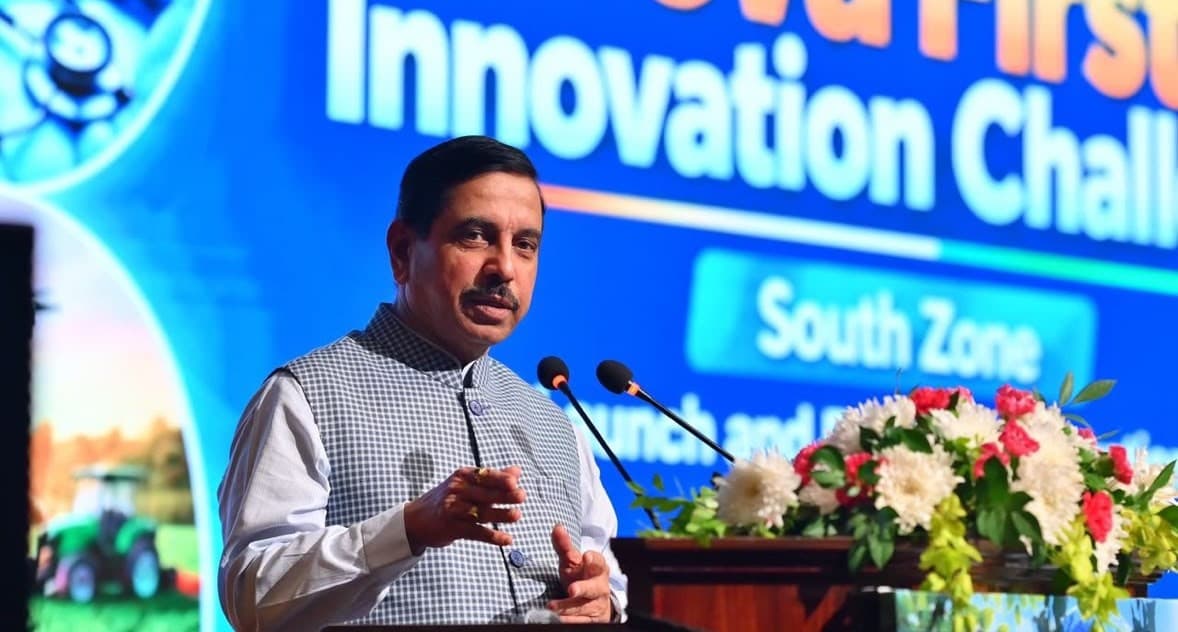
Bengaluru: Union Education Minister Pralhad Joshi has called upon young people to combine the spirit of ‘Seva’ (service) with innovation to identify real-world challenges and develop practical, scalable solutions that can contribute to the vision of Viksit Bharat @2047.
Joshi was speaking after inaugurating the Seva First Innovation Challenge (SFIC) for the South Zone at the Indian Institute of Science (IISc), Bengaluru, on Friday. He also launched the initiative's website and registration portal.
“Seva must find expression in action,” Joshi said, emphasising that understanding a problem and developing an innovative solution that can address it at scale represents an important form of service to society.
Turning India's demographic dividend into innovation
Highlighting India's demographic advantage, the minister said nearly 65 per cent of the country's population is below the age of 35.
He described the younger generation as curious, confident and comfortable with technology and stressed the importance of creating opportunities for young people to convert their curiosity into meaningful action.
Joshi said the National Education Policy (NEP) 2020 places critical thinking, creativity, experiential learning and problem-solving at the centre of education.
According to the minister, the policy's approach is being translated into opportunities for students to experiment, build and innovate from an early age.
Expanding India's innovation ecosystem
Joshi highlighted several government initiatives aimed at strengthening India's innovation ecosystem.
These include more than 10,000 Atal Tinkering Labs, around 17,300 Institutions Innovation Councils and initiatives such as the Smart India Hackathon.
He said innovation guided by the spirit of Seva could make a meaningful contribution to the Viksit Bharat @2047 vision.
The minister also encouraged start-ups and industry partners to engage with young innovators participating in the challenge and help promising ideas move towards practical implementation.
National repository planned for promising ideas
Joshi suggested creating a national repository through the SFIC website to preserve promising solutions emerging from the challenge.
Such a repository, he said, could facilitate future mentoring, adoption and scaling of innovative ideas.
He congratulated IISc Bengaluru, participating institutions, faculty members, start-ups and other stakeholders involved in organising the initiative.
The minister said he expected the strongest solutions from across the country to be showcased at the National Finale in New Delhi in December 2026.
IISc Bengaluru to coordinate South Zone
IISc Bengaluru will serve as the South Zone Nodal Institute for the challenge and provide technical evaluation and mentorship.
The South Zone will cover Karnataka, Tamil Nadu, Kerala, Andhra Pradesh, Telangana, Puducherry, Andaman and Nicobar Islands and Lakshadweep.
The initiative will bring together students and young innovators from schools, ITIs, polytechnics, colleges and universities.
Five national themes
The SFIC will invite solutions across five broad national themes:
- Clean and Sustainable Bharat
- Prosperous Farmers, Prosperous Bharat
- Healthy and Inclusive Bharat
- Educated and Skilled Bharat
- Secure Bharat
The challenge will have two solution tracks.
Track A will focus on product and technology-based solutions, while Track B will focus on business models and governance solutions.
Rather than limiting participation to idea submission, the programme aims to provide promising innovators with mentoring, incubation support and pathways towards real-world adoption.
Registration open until October 24
Registration for the Seva First Innovation Challenge will remain open from September 25 to October 24, 2026.
The National Finale is scheduled to be held in New Delhi in December 2026.
The initiative is designed to create a pathway for young innovators to move from identifying societal challenges to developing, testing and potentially scaling solutions.
IISc, academic and industry representatives attend
IISc Bengaluru Director Prof. Govindan Rangarajan, Department of Higher Education Additional Secretary Anandrao V. Patil and University Grants Commission Secretary Prof. Shyama Rath attended the event.
Directors and representatives of NITs and other institutions, faculty members, industry and start-up representatives, students and young innovators also participated.
The challenge seeks to connect India's student and young-innovator community with academic institutions, industry and start-ups, with the broader objective of turning innovation into solutions addressing social and national priorities.