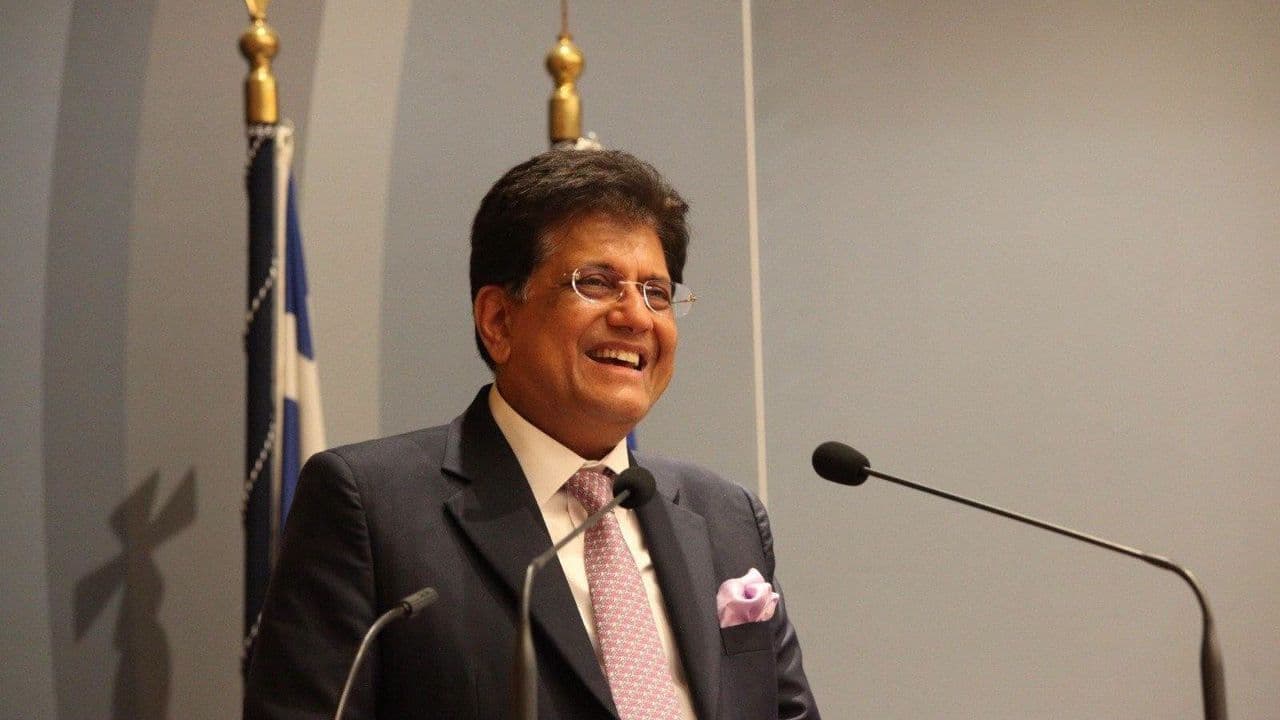
New Delhi: Union Commerce and Industry Minister Piyush Goyal on Monday said technology-enabled bilingual management education has the potential to bridge the rural-urban divide and make quality higher education accessible to talented students irrespective of their location or economic background.
Virtually inaugurating the newly launched bilingual Bachelor of Business Administration (BBA) programme at the Indian Institute of Management (IIM) Udaipur, Goyal described the initiative as a significant step towards democratising management education through technology. The programme, offered in both Hindi and English, aims to widen access to the globally recognised IIM brand while making learning easier for students from diverse backgrounds.
Highlighting India's digital transformation, the Minister said the country now has nearly 100 crore internet users, creating unprecedented opportunities to expand quality education through virtual platforms in line with the National Education Policy (NEP). He noted that students from remote regions would now be able to access IIM classrooms through smartphones, laptops and other digital devices, while offline examinations would ensure academic credibility and accountability.
Goyal outlined four key suggestions to strengthen the programme. He recommended regular physical interactions between faculty and students through the hybrid model, saying management education extends beyond classrooms and benefits greatly from peer interaction and networking.
He also emphasised the importance of soft-skill development, including communication, teamwork, cultural exposure and technology proficiency, alongside academic learning. As a third recommendation, the Minister called for experiential learning through visits to factories, ports and industrial clusters, enabling students to gain practical management exposure.
His fourth suggestion focused on adopting global best practices by integrating digital tools, audio-visual learning, research internships, credit transfers under the NEP and collaborations with leading national and international institutions.
The Minister said India's rapidly expanding network of free trade agreements is opening new opportunities for manufacturing, innovation and entrepreneurship, creating a favourable environment for the country's youth. Students, he said, should combine academic knowledge with practical experience to take advantage of emerging global opportunities.
Referring to the transformation of education during the COVID-19 pandemic, Goyal said educational technology had evolved from a supplementary tool into an essential component of modern learning. He added that virtual education has successfully connected students from villages and cities, making quality education more inclusive.
Observing that artificial intelligence and emerging technologies are reshaping management education and employment, Goyal said dynamic learning and continuous skill upgradation have become essential for future careers.
Expressing confidence in the initiative, the Minister said the inaugural batch of students would create history and contribute significantly to India's journey towards becoming a developed nation while strengthening the global reputation of Indian Institutes of Management.