Mangalagiri: The Andhra Pradesh government is stepping up its efforts to attract investments and generate employment, with the Telugu Desam Party (TDP) highlighting recent industrial approvals, corporate outreach and emerging technology initiatives as key elements of the state's economic strategy.
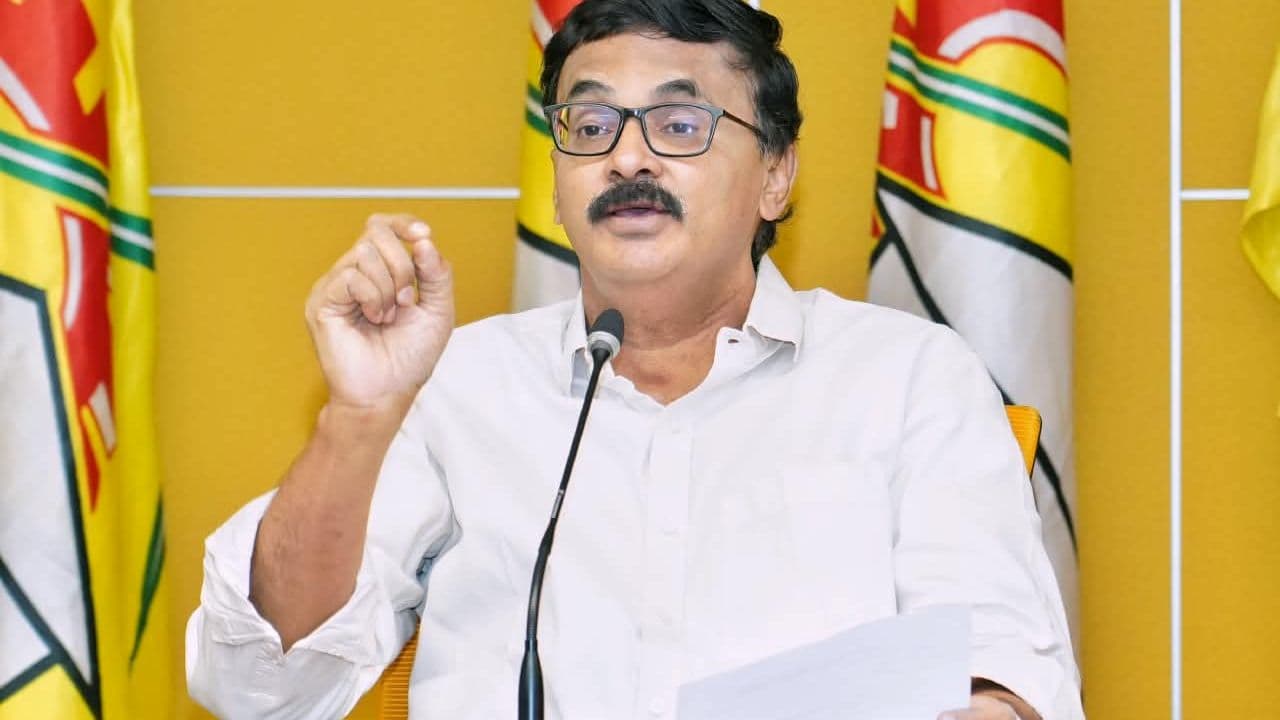
Addressing the media at the TDP Central Office in NTR Bhavan, Mangalagiri, Biodiversity Board Chairman Neelayapalem Vijay Kumar said the government was pursuing an investment-led approach focused on wealth creation and asset development.
Vijay Kumar contrasted the present government's approach with what he described as the previous administration's reliance on taxation and borrowing. His remarks were made as part of the TDP's assessment of the coalition government's investment and economic initiatives.
SIPB Approves Rs. 22,177.84 Crore in Projects
The TDP pointed to the latest approvals of the State Investment Promotion Board (SIPB) as evidence of increased investment activity in Andhra Pradesh.
At its 21st meeting, chaired by Chief Minister N Chandrababu Naidu, the SIPB approved 28 industrial proposals involving Rs. 22,177.84 crore, with the projects expected to create employment opportunities for 19,739 people, according to government figures cited by the party.
The proposals cover sectors including energy, information technology and communications, food processing, manufacturing and tourism.
The government has also directed officials to facilitate faster implementation of approved projects, with a six-month timeline for commencement of production-related activity.
According to figures cited in the assessment, the latest approvals have taken the cumulative number of SIPB-cleared projects to 387, involving proposed investments of approximately Rs. 14.05 lakh crore and potential employment for 10.79 lakh people.
The state's Industrial Development Policy 4.0 identifies investment attraction, faster project implementation, manufacturing growth, employment generation and development of industrial parks among its key objectives.
Lokesh Steps Up Corporate Outreach
Vijay Kumar said the state had adopted a more proactive investment outreach strategy, with IT and Education Minister Nara Lokesh engaging directly with corporate executives and industry representatives.
He referred to roadshows and meetings in major economic centres, including Delhi and Ahmedabad, where Andhra Pradesh's investment opportunities and industrial ecosystem were presented to prospective investors.
The TDP said the emphasis was increasingly shifting from signing memoranda of understanding to converting investment proposals into operational projects and employment opportunities.
Push for Semiconductors, AI and Quantum Technology
The state is also seeking investments in emerging sectors such as semiconductors, chip manufacturing, artificial intelligence and quantum technologies.
The latest SIPB discussions included plans to develop Andhra Pradesh as a hardware manufacturing destination and strengthen electronics hubs in Kopparthy, Tirupati and Lepakshi.
Officials have also been asked to develop an ecosystem covering research, product design and manufacturing.
According to the TDP's assessment, 10 technology projects approved during the latest investment cycle involve investments of more than Rs. 500 crore and are expected to create nearly 9,000 jobs, with several projects linked to quantum technology.
The government is simultaneously pursuing the development of Amaravati Quantum Valley as a deep-technology hub.
Amaravati Quantum and AI Campus
Another major technology initiative highlighted by the party is the proposed Quantum and Artificial Intelligence campus in Amaravati by the National Institute of Electronics and Information Technology (NIELIT), under the Union Ministry of Electronics and Information Technology.
The campus is intended to focus on areas including quantum computing, artificial intelligence, quantum communication and cybersecurity, quantum hardware and high-performance computing.
The initiative is part of the broader effort to establish an advanced technology ecosystem in Amaravati and develop specialised skills for emerging industries.
Major Companies Cited in Investment Push
The TDP also highlighted investment interest from companies across energy, information technology, manufacturing and infrastructure.
Companies cited in the party's assessment include Adani Group, ArcelorMittal Nippon Steel, NTPC Green Energy, Reliance Industries, Tata Power, Brookfield Renewable, Yotta Data Services, ReNew Power and Torrent Group.
In the IT sector, the party pointed to planned expansion by Tata Consultancy Services (TCS), Cognizant and Deloitte, particularly in Visakhapatnam.
The TDP also referred to potential and planned activity involving LG Electronics, Century Plyboards, TAFE, AM Green, Cisco Systems and Skyroot Aerospace in manufacturing, energy, technology and aerospace-related sectors.
Skills Development Linked to Employment
Vijay Kumar said attracting investment would need to be accompanied by workforce development to ensure young people could take advantage of employment opportunities emerging from new industries.
The TDP highlighted the state's AI-driven Skill Census, which it described as an initiative to map the skills and employability profile of young people.
The party said investment attraction and skill development were being aligned with the coalition government's stated objective of creating 20 lakh jobs over the coming years.
The government has also been positioning Amaravati and Visakhapatnam as emerging centres for advanced technology, IT and innovation, while seeking to develop industrial ecosystems around manufacturing, energy, logistics and other sectors.
Execution to Determine Investment Outcomes
The latest SIPB approvals and technology initiatives form part of Andhra Pradesh's broader investment strategy.
While the government and the TDP have highlighted the scale of proposed investments and projected employment, the conversion of approved proposals into operational projects and actual jobs will depend on project implementation, financing, infrastructure and other execution factors.
The state has formally identified faster investment realisation and improving the ease of doing business as important elements of its industrial policy framework.